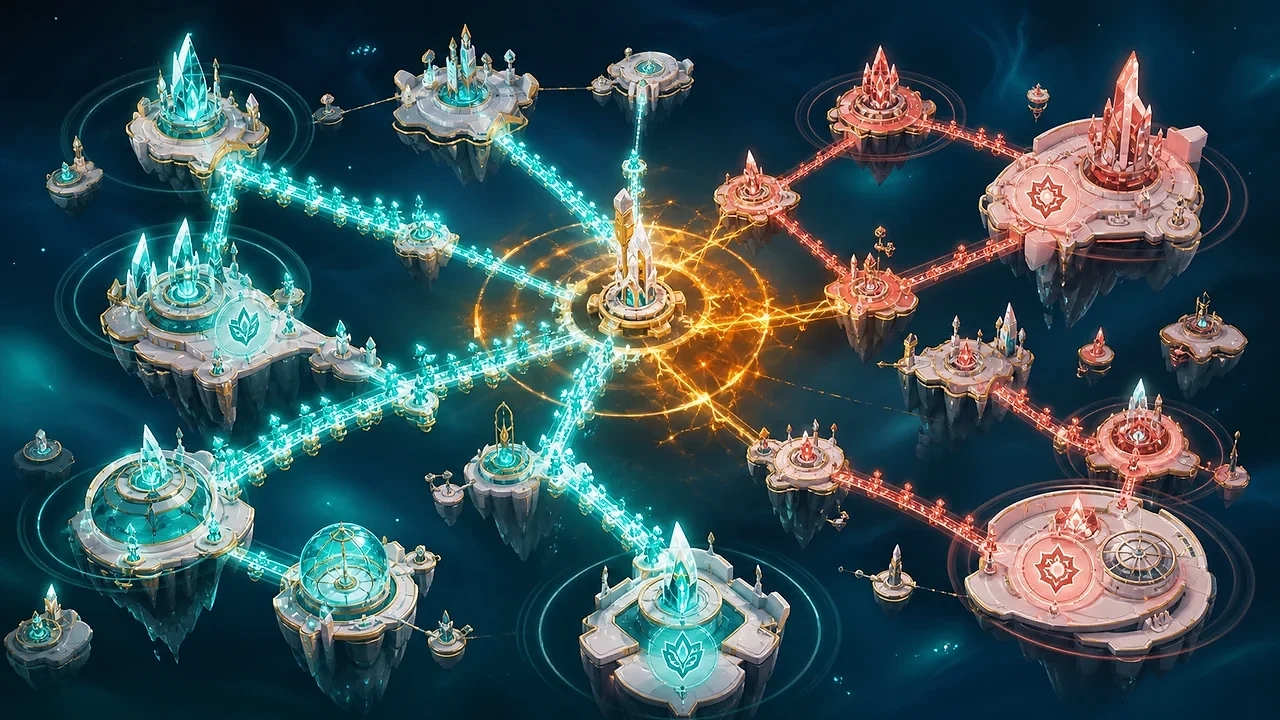
Signal Frontiers is a short browser strategy game about capturing an abstract network of floating relay islands. Draw temporary routes, send beat-timed pulses, alternate striped and dotted link frequencies to build Resonance, then Overload a relay for a risky map reversal. Matches are deterministic, use original fictional maps, and usually finish in one to three minutes.
Session1–3 min
ControlsTouch + mouse
DifficultyEasy to read, tactical to master
CostFree to play
Updated
How to play Signal Frontiers
Drag from an owned node through connected relays, then release to commit a route.
Sweep across up to four owned nodes, then release on one target for a coordinated rush.
Use arrow keys and Space to build a route; press Enter to commit it.
Hold an owned non-Core relay or press O at full Resonance to trigger Overload.
Tips
Opposing pulses cancel one-for-one when they meet on a two-way link.
Alternate striped A and dotted B link arrivals to charge Resonance.
Protect short routes into your Core before expanding to a second front.
Overload doubles output but removes the relay's reserve and shield, so time it carefully.
What to notice on your first run
Every owned node emits on the visible beat. Friendly pulses reinforce a relay, while hostile pulses remove its shield and charge before a short, readable capture telegraph changes ownership. Routes are temporary, so winning requires reading when to reinforce a cut node and when to redirect production toward the rival Core.
Why this mechanic works in a short session
Striped A links and dotted B links are gameplay information, not decoration. Successful alternating arrivals fill four Resonance segments. A full meter can Overload an owned non-Core relay for three beats of doubled output, but the relay loses its shield and reserve. That exposed comeback window is Signal Frontiers’ central risk.
Original deterministic strategy
Signal Frontiers uses fictional floating relay networks rather than countries or political maps. AI sees the same public board as the player and receives no hidden production bonus. The same seed and ordered actions produce the same replay checksum, making retries useful for learning a cleaner route.
Frequently asked questions
Signal Frontiers v1 is single-player. It does not use real countries, national flags, or multiplayer ranking. A typical match lasts about one to three minutes, and all controls work with touch, mouse, or keyboard.
A shorter browser strategy alternative
Signal Frontiers compresses territory conquest into a one-to-three-minute match: routes expire, every node emits on a visible beat, and Overload trades reserve for a temporary production spike. For a longer defensive planning loop, Lumen Bastion: Riftfall uses fixed sockets, wave forecasts, and four escalating shifts. Both appear in the short browser strategy games hub.
Signal Frontiers FAQ
What is Signal Frontiers?
Signal Frontiers is a short browser strategy game about capturing an abstract network of floating relay islands. Draw temporary routes, send beat-timed pulses, alternate striped and dotted link frequencies to build Resonance, then Overload a relay for a risky map reversal. Matches are deterministic, use original fictional maps, and usually finish in one to three minutes.
How do you play Signal Frontiers?
Drag from an owned node through connected relays, then release to commit a route. Sweep across up to four owned nodes, then release on one target for a coordinated rush. Use arrow keys and Space to build a route; press Enter to commit it. Hold an owned non-Core relay or press O at full Resonance to trigger Overload.
What are some tips for Signal Frontiers?
Opposing pulses cancel one-for-one when they meet on a two-way link. Alternate striped A and dotted B link arrivals to charge Resonance. Protect short routes into your Core before expanding to a second front. Overload doubles output but removes the relay's reserve and shield, so time it carefully.